
Beyond Synagogue Lane: The Secret Side of Jew Town Kochi”
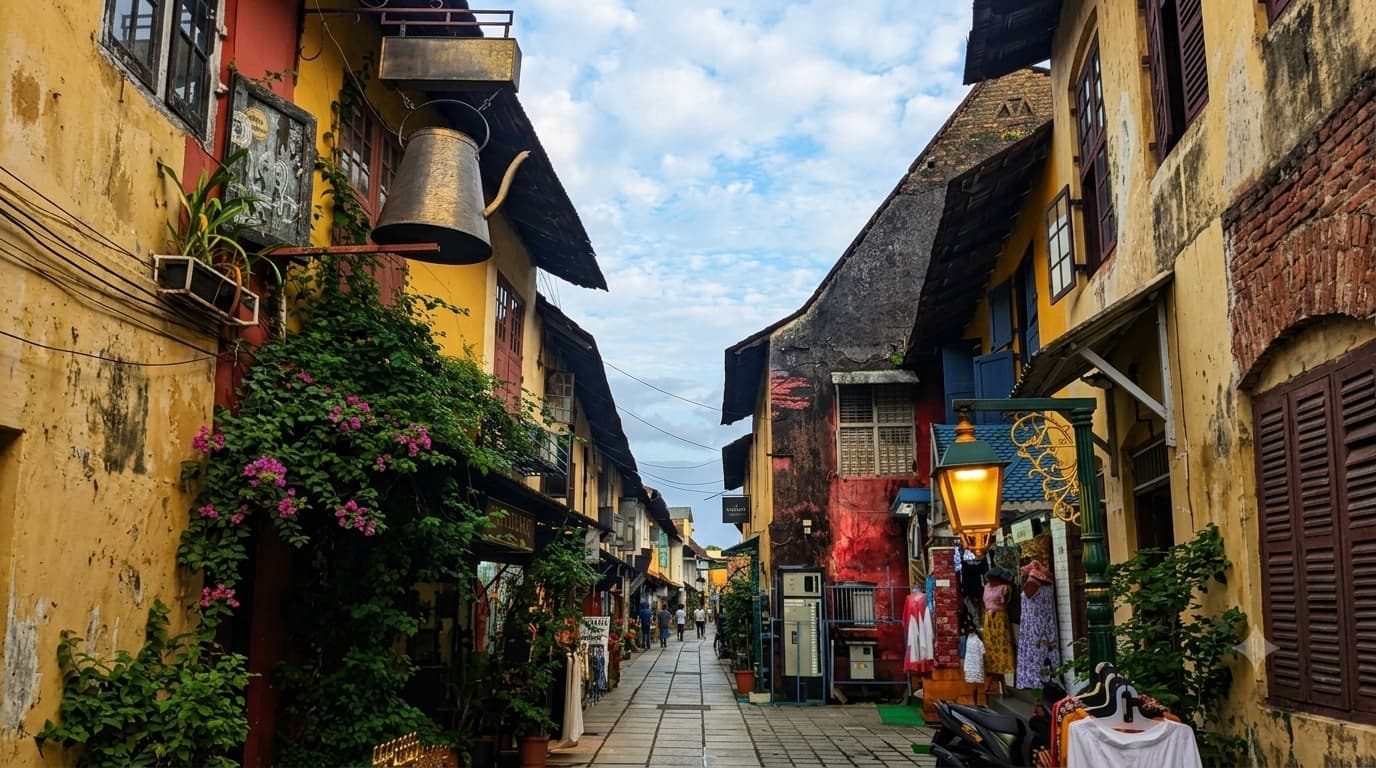
At 7:00 AM, Mattancherry wakes up. Merchants have not yet rolled up their souvenir shutters. Tour buses are nowhere to be seen on Synagogue Lane. Step just ten meters behind the main tourist drag. Here, polished antique storefronts vanish. A maze of centuries-old backlanes takes their place, wrapped in morning mist and curing ginger. This is Jew Town at its most authentic. Dutch-era spice warehouses still echo with the heavy thud of burlap sacks. Quiet residential alleys hold the subtle, fading marks of a shared past. Travelers can easily skip the generic checklist and explore on foot. These hidden places in Jew Town Kochi offer an unfiltered look into Kochi’s maritime engine.
Inside the pandikashalas : The Architecture of Old Spice Warehouses
Among the most impressive hidden places in Jew Town Kochi, massive spice warehouses form the core backstreet network. Locals call these historic structures pandikashalas. Engineered during Portuguese and Dutch colonial regimes, these expansive maritime buildings feature a distinct dual-purpose layout. Heavy trade operations occupied the ground floor. Meanwhile, upper timber levels served as private residential quarters for merchant families.
- Heavy Teak Entrances: Look closely at the ground-level entrances along the rear backlanes. Massive double-leaf teak doors feature hand-forged iron studs. Builders designed them to withstand heavy monsoon dampness and prevent break-ins during high-value spice storage.
- High Attic Louvers: Notice the deep-set wooden vents perched high beneath low-slung, red-tiled clay roofs. Dutch engineers designed these high louvers to vent heat and toxic spice dust into the sea breeze naturally. At the same time, the design kept sudden monsoon downpours from ruining dry cargo inside.
- Internal Courtyards: Behind heavy wooden street doors lie hidden open-air courtyards (muttams). Here, workers spread raw ginger root on woven bamboo mats to sun-cure before export..
“We still sort black pepper by hand because machines miss the small stems,” explains Moideen, a second-generation warehouse worker on Bazaar Road whose family has handled spice cargo here since the 1970s. “The trade is quieter now than it was thirty years ago, but the routine doesn’t change.”
Traces on the Plaster: Finding Mezuzahs and Star-of-David Grilles
As you navigate quiet residential lanes connecting Jew Town to Mattancherry’s trade market, home architecture reveals a rich, multi-ethnic past. Fading details offer subtle clues at every turn.Keep an eye out for distinct architectural markers left behind by generations of Jewish families who once inhabited these lanes.
- Mezuzah Recesses: Look closely at the right-hand wooden doorpost of mid-20th-century residential homes along Synagogue Lane’s rear exits. You will spot small, carved rectangular slots. These slots mark where traditional mezuzah parchment scrolls once sat. Families placed them here before their historic emigration to Israel.
- Wrought-Iron Motifs: Glance upward at second-story residential balconies, transom windows, and iron security grilles. Many traditional homes feature delicate wrought-iron craftsmanship shaped into six-pointed Stars of David. Craftsmen cleverly intertwined these stars with traditional Kerala floral motifs and Dutch-style arched window frames. These residential alleys remain some of the most rewarding hidden places in Jew Town Kochi to explore on foot.
In the mid-20th century, Jew Town held over 250 Paradesi Jewish residents. They operated thriving timber, spice, and printing businesses. After Israel’s creation in 1948, migrations began. Ownership of many homes shifted to local Muslim and Christian merchant families. Today, only a few elders of the original community remain. However, the new custodians actively preserve the historic doorframes, brass fixtures, and street names.
Field Vocabulary: Architectural Glossary
- Pandikashala: Traditional timber-and-masonry spice warehouse with ground-floor storage and upper residential quarters.
- Muttam: Open-air internal courtyard designed for drying ginger, pepper, and nutmeg in natural sunlight.
- Kappiri Mathil : Compound wall niches dedicated to protective guardian spirits, marked by soot and candle wax.
- Nilavara: Reinforced cellar or vaulted underground room used in colonial-era homes to secure valuable spices and metals.
The Olfactory Trail: Sights, Sounds, and Scents of Bazaar Road
Running directly parallel to the waterfront, Bazaar Road serves as the noisy, industrial engine room behind Jew Town’s peaceful facade. Turning north off the quiet backlanes into this narrow thoroughfare shifts your senses completely. You step directly into an active 19th-century trade center.
- The Olfactory Sensation: The thick coastal air carries an intense, shifting aroma. You will smell raw ginger, crushed cinnamon bark, and cardamom pods. Dusty black pepper sacks pile high inside dark timber warehouse bays.
- The Soundscape: Listen closely to the continuous, rhythmic thud of manual spice sorting. Workers scrape dried ginger roots across rough burlap sacks. Heavy wooden shovels move pepper across stone floors. Nearby, iron wheels of handcarts rattle against aged asphalt.
- Manual Spice Sorting: Step back to let head-loaders (chumattu thozhilalikal) pass through. They carry 50-kilogram burlap sacks from timber warehouses onto waiting transport trucks. This manual labor system has survived unchanged for generations.
Whispers in the Masonry: The Legend of Kappiri Muthappan
As you trace the outer perimeter of these hidden places in Jew Town Kochi heading toward Mangattumukku, the neighborhood history takes a dark and deeply mystical turn. Built directly into the base of several century-old compound walls, you will notice small, soot-stained stone ledges known locally as Kappiri Mathil.
Local folklore dates back to the 1663 Dutch siege. Fleeing Portuguese noblemen buried their gold, silver, and jewels inside thick granite walls. To protect this hidden wealth, local tradition tells a tragic story. Portuguese owners chained African slaves (Kappiris) inside the wall cavities. They walled them up alive to guard the treasure forever.
Over centuries, fear transformed into deep neighborhood reverence. Today, locals across all religious backgrounds treat Kappiri Muthappan as a benevolent protector. At dusk, residents still pause near these wall niches. They light small wax candles and leave traditional offerings of country cigars, dark arrack, and freshly fried fish.
A.B. Salem Road & The Silent Jewish Cemetery
Branching off near the main market strip lies A.B. Salem Road, a narrow, shaded residential lane named after Avrabham B. Salem, the prominent Indian Jewish lawyer, nationalist, and community leader who fought for social equality within the Cochin Jewish congregation.
At the quiet terminus of this residential street sits the historic Jewish Cemetery. High perimeter walls and locked iron gates guard the site. Looking through the iron bars reveals weather-worn, moss-covered tombstones. Ancient Hebrew script adorns the stones, partially swallowed by wild greenery and fallen coconut fronds. This peaceful monument offers silent memory. It provides a stark contrast to the lively antique market just a two-minute walk away.
Crossing Calvathy Canal: The Frontier Between Mattancherry and Fort Kochi
Following the backstreets further north brings you to the historic Calvathy Canal bridge, an overlooked boundary point that shaped modern Kochi’s urban geography.
Historically, this narrow, murky waterway served as the official political border separating European-controlled Fort Cochin (occupied sequentially by the Portuguese, Dutch, and British) from the native trading domain of the Kingdom of Cochin (Mattancherry). Today, old wooden cargo boats (kettuvallams) and small fishing vessels still moor along the canal banks, framed by decaying Dutch-era masonry walls and low-slung wooden tea shops where dockworkers gather for morning chai.
Off the Spice Trail: The Washerfolk Yards and Shrines of Veli
Heading west through the winding backstreets, your walk eventually brings you to the heritage Dhobi Khana in Veli. The story of this open-air laundry dates back to the Dutch colonial era, when members of the ‘Vannar’ community were brought here from Coimbatore and Tirunelveli in Tamil Nadu to wash uniforms for the Dutch army. Beyond the usual postcard sights of Kochi, this enclave offers a rare, down-to-earth glimpse into a culture that has preserved its true identity.
Inside, the yard is neatly divided into individual cubicles, each equipped with dedicated washing bays and stone slabs for every family. Under the blazing tropical sun, long lines of crisp white linens and vibrant fabrics flutter on traditional coconut-fiber ropes—a timeless daily scene. These historic washing yards stand as a living testament to the grit, hard work, and quiet resilience of a community that has nurtured its ancestral trade across centuries.
The Anchor Monuments: Paradesi Synagogue & Mattancherry Palace
While the backlanes hold the neighborhood’s quiet secrets, no visit to Mattancherry is complete without understanding its two primary historical anchors. Standing at opposite ends of the trade district, these monuments explain why this narrow peninsula became a global hub of royalty, religion, and commerce:
- The Paradesi Synagogue (Jew Town Main Street): Built in 1568 by the Sephardic and White Jewish community (Paradesi meaning “foreigners”), this is the oldest active synagogue in the Commonwealth. Stepping inside reveals hand-painted, blue-and-white willow pattern floor tiles imported from Canton, China in the 18th century, Belgian crystal chandeliers, and centuries-old silver Torah crowns gifted by the Rajahs of Cochin.
- Mattancherry Palace / The Dutch Palace: Built around 1555 by the Portuguese as a gift to the Rajah of Cochin (Veera Kerala Varma) to secure trading rights, and later extensively renovated by the Dutch in 1663. Despite its plain, quadrangular colonial exterior, the interior rooms showcase incredible traditional Kerala padippura architecture and world-renowned 16th-century Hindu temple-style murals depicting scenes from the Ramayana and Mahabharata.
Connecting the Loop: The Heritage Highlights of Fort Kochi
If Jew Town and Mattancherry represent the industrial spice engine and cultural mosaic of the area, neighboring Fort Kochi (just 2 kilometers west along Calvathy Road) serves as its colonial seaside anchor. To complete a full-day heritage circuit, most travelers combine the quiet backlanes of Mattancherry with Fort Kochi’s iconic landmark loop:
- The Chinese Fishing Nets (Cheena Vala): Suspended along the Fort Kochi beach promenade, these massive teak-and-bamboo cantilevered fishing structures were introduced by Chinese traders from the court of Kublai Khan in the 14th century and remain active working icons today.
- St. Francis Church: Built by Portuguese friars in 1503, this is widely recognized as the oldest European-built church in India. It famously served as the original burial site for explorer Vasco da Gama before his remains were moved to Lisbon.
- Santa Cruz Basilica: A striking Gothic-revival cathedral featuring soaring arches, pastel-hued interiors, and intricate ceiling frescoes painted by Italian artist Antonio Moscheni.
- Princess Street & Parade Ground: Lined with European-style colonial bungalows, art galleries, and open-air cafes, these shaded avenues offer a stark visual contrast to the dense, working-class industrial architecture of Mattancherry’s spice lanes.
Local Eats: Where to Refuel Along the Backlanes
- Kochi Roti Maker (Bazaar Road): An unassuming local favorite tucked along the spice corridor. Stop here in the morning for hot, paper-thin fluffy appams, parottas, and beef roast or vegetable stew alongside local spice traders.
- Kayees Rahmathulla Hotel (Gujarati Road / Mattancherry): Legendary across Kerala for its traditional Mattancherry Mutton Biryani. Cooked over firewood using short-grain Kaima rice and aromatic spices, it is the ultimate lunch reward after a long morning walk.
- Crafters Cafe / Heritage Courtyards (Jew Town Main Street): If you need air-conditioned comfort, step into one of the restored pandaka courtyard cafes for iced cold brew, fresh passion fruit juice, or spice-infused teas surrounded by antique timber architecture.
- Local Tea Stalls (Chai Kada) near Calvathy Canal: For an authentic local break, grab a glass of meter-frothed Meter Chai paired with hot Pazham Pori (banana fritters) at the canal-side stalls where dockworkers gather.
How to Reach Jew Town & The Backlanes.
Reaching Mattancherry is straightforward, with transit options varying depending on your starting point in Kochi:
From Cochin International Airport (COK) (~42 km / 1 hour 15 mins):
By Taxi (Easiest): Pre-book a prepaid airport taxi directly from the terminal to Mattancherry Dutch Palace / Jew Town entry. Fares typically range between ₹1,200 – ₹1,500.
By Airport Bus + Water Metro (Budget/Scenic): Take the KSRTC FlyBus from the airport terminal to Ernakulam KSRTC Stand or Jetty. From there, head to the Ernakulam Water Metro Jetty and take the scenic electric boat across the harbour to Mattancherry Jetty.
From Ernakulam Railway Stations (Ernakulam Junction – South / Ernakulam Town – North):
From Ernakulam Junction (ERS – South): Take an auto-rickshaw or taxi to the Ernakulam Boat Jetty (10 mins / ~2.5 km), then hop on the public ferry or Water Metro to Mattancherry. Alternatively, take a direct auto/cab via Willingdon Island (approx. 25–30 mins / ₹300–₹400).
From Ernakulam Town (ERN – North): Take a city bus or auto to the Ernakulam Boat Jetty, or hire a direct cab directly to Mattancherry via the Mattancherry Bridge (approx. 35 mins).
Local City Transit (Ferry, Bus & Auto):
By Water Metro / SWTD Ferry:
High-frequency ferries run from Ernakulam Main Jetty directly to Mattancherry Jetty. From the dock, it is a flat, scenic 5-minute walk down to Jew Town Road.
By City Bus
Board any bus marked Mattancherry, Chullikkal, or Thoppumpady from Kaloor, Jos Junction, or South Station. Get off at the Mattancherry Bus Stop near the Palace.
Parking Tip for Cars
Roads inside Jew Town and Bazaar Road are too narrow for cars. Park at the designated paid parking grounds near Mattancherry Palace or the waterfront parking bay before exploring on foot.
”If Jew Town and Mattancherry form the historical core of your day trip, you can easily combine them with Fort Kochi for a complete weekend circuit. Check out our 7 places 2-day Kerala itinerary to see how to fit Kochi into a short trip.”
Jew Town Kochi Walking Route: Practical Maps, Timing, and Etiquette
Recommended Self-Guided Walking Sequence
- Start: Jew Town Main Street & Synagogue Lane (7:30 AM).
- Cut East: Step into the Pandaka rear alleys directly behind Synagogue Lane.
- Loop North: Walk down Bazaar Road to observe active spice packing and manual warehouse operations.
- Cultural Detour: Visit the Kappiri Thara wall shrine near Mangattumukku.
- Quiet End: Head down A.B. Salem Road to view the Jewish Cemetery gates, finishing your walk across Calvathy Canal toward Fort Kochi.
Essential Visitor Tips & Field Notes
- Best Natural Light: 7:15 AM – 8:30 AM. Sunlight hits the east-facing timber facades of Bazaar Road at a low angle, highlighting texture on old lime walls.
- High-Activity Windows: Head-loaders and handcart operators are most active between 8:00 AM and 10:30 AM before trucks fill the lanes.
- Local Photography Etiquette: Many pandakas and spice sorting units are active private working spaces. Always ask for a quick nod of permission before photographing dockworkers inside dark warehouse bays or taking close-up pictures at local shrines. Avoid pointing lenses directly inside active residential living quarters on A.B. Salem Road.
- Footwear: Wear durable, flat walking shoes. The backlanes feature uneven stone paving, high timber door sills, and slick wet pavement near active washing areas.
Conclusion
What makes exploring Hidden Places in Jew Town Kochi is so memorable isn’t just the history—it is the feeling that past and present are still actively wrestling in the same space. As your morning walk winds down near Calvathy Canal, you realize that this neighborhood’s identity was never defined by a single street or monument. It lives in the quiet contrast between silent Jewish tombstones and noisy spice docks, and in the enduring local traditions that keep old wall shrines lit at dusk. When you finally leave Mattancherry, it isn’t the souvenir trinkets you remember, but the sensory weight of the experience: the dust of black pepper in the air, the cool shade of Dutch eaves, and the quiet satisfaction of having discovered a side of Kochi that most travelers walk right past.