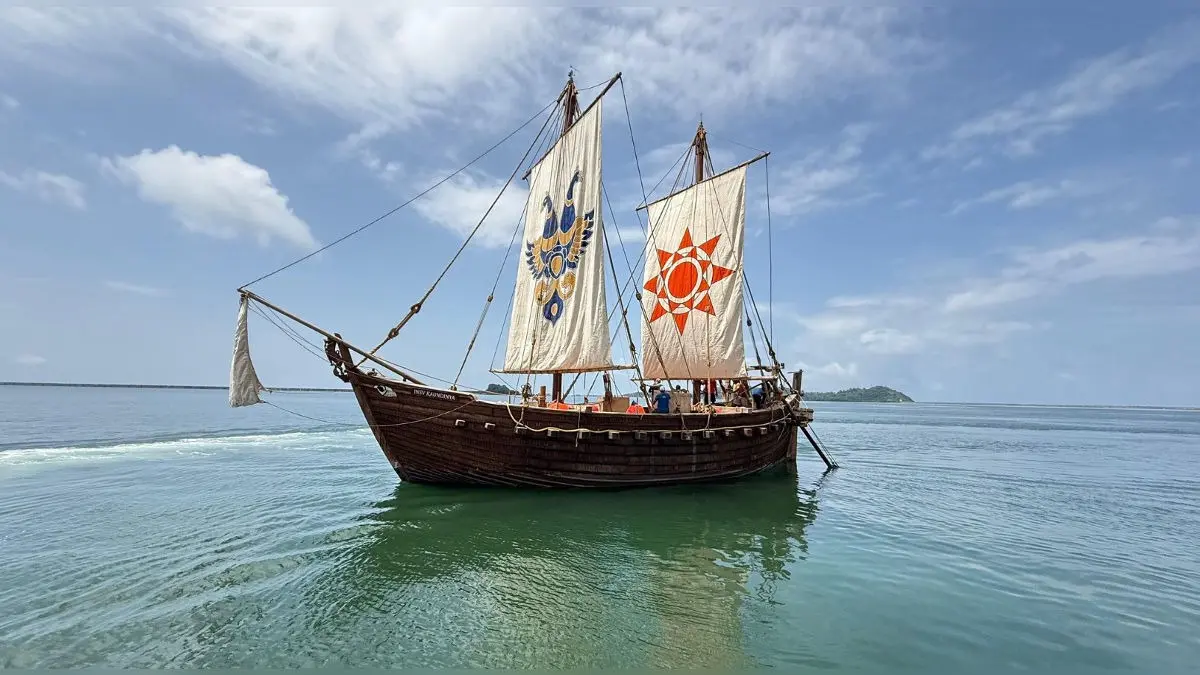

As the sun glints off the azure waters of the Arabian Sea, a vessel unlike any other in the modern Indian Navy prepares to catch the wind. It has no engine to roar into life, no propellers to churn the wake, and not a single metal nail holding its wooden hull together. This is the INSV Kaundinya—a ship that is less a machine and more a living time capsule.
The inspiration for this ambitious project stems from the vision of Sanjeev Sanyal, Member of the Prime Minister’s Economic Advisory Council. Sanyal sought to prove that India’s ancient maritime influence was not a myth of the past but a reality built on sophisticated, homegrown technology. By retracing the ancient “Spice Route,” the Indian Navy and the Ministry of Culture are reviving a forgotten chapter of history through “experimental archaeology,” proving that the ancestors of the Indian subcontinent mastered the oceans through indigenous genius.
The Journey from Cave Art to Waves of History
The blueprint for the INSV Kaundinya was not found in a modern naval archive, but rather on the ancient, rock-cut walls of the Ajanta Caves. Specifically, Cave No. 2 features a world-renowned mural from the 5th century CE depicting a multi-masted ship braving the waves. This artistic record serves as a primary historical source, proving that ancient Indian shipbuilders had mastered complex rigging and hull designs long before European explorers arrived in the Indian Ocean.
By studying these frescoes alongside historical texts, researchers were able to reconstruct the aesthetic and functional silhouette of the Kaundinya. This voyage is, in essence, an ancient painting coming to life, validating the artistic heritage of Ajanta as a factual record of India’s naval prowess.
The Legend of Kaundinya: Design, Technology, and the Stitched Hull
The vessel is named after the legendary Indian figure Kaundinya, who, according to historical accounts, sailed across the Bay of Bengal to the Mekong Delta to found the Funan Empire. To honor this legacy, the ship’s design is a masterclass in ancient engineering. Stretching 13.15 meters in length with a beam (width) of 4.3 meters and a draft of 1.6 meters, the ship displaces approximately 14 tonnes.
Unlike modern ships held together by steel and rivets, the Kaundinya utilizes the “stitched ship” technique. Its planks, carved from premium teak wood, are sewn together using over 4,000 meters of coconut fiber (coir) rope. The seams are then sealed with a traditional concoction of fish oil, lime, and resin. This “stitched” design is not a primitive flaw but a sophisticated advantage; the hull remains flexible, allowing it to “breathe” and absorb the impact of heavy swells rather than cracking under the rigid pressure of the ocean’s force.
Kerala Artisans Bring INSV Kaundinya to Life
While the vessel took shape in Goa, its heart beats with the heritage of the Malabar Coast. The construction was spearheaded by Babu Shankaran, a master shipbuilder whose family has preserved the secrets of traditional naval architecture for generations. Shankaran’s expertise is a bridge to the legendary Uru making tradition of Kerala—the craft of building massive wooden dhows that have sailed to the Gulf for centuries.
For the people of Kerala, the Kaundinya is a tribute to the state’s enduring status as the world’s maritime gateway. The ship utilizes the same high-quality teak and coconut fiber—the literal threads of the Kettuvalam tradition—that once made Kerala the premier destination for global shipwrights. It is a celebration of a craftsmanship that has survived in the backwaters and coastal yards, now being utilized by the Indian Navy to reclaim a civilizational narrative.
Life on the High Seas: The “One Pot, One Sailor” Philosophy
Life aboard the INSV Kaundinya is a stark departure from the comforts of modern naval service. Without an engine, the crew is entirely at the mercy of the seasonal monsoon winds, requiring a constant, grueling vigil over the sails. There is no refrigeration and no modern galley; instead, the crew adheres to a “one pot” philosophy.
Meals are simple, cooked in a single vessel using preserved ingredients, mirroring the austere lives of ancient mariners. Space is so limited that every movement must be calculated, and every drop of fresh water is treated as gold. This minimalist existence is a psychological and physical journey, forcing the modern sailor to develop the same “sea-sense” that guided their ancestors across the horizon using only the stars and the smell of the wind.
Strengthening the Horizon: The India-Oman Maritime Nexus
The 1,500-kilometer voyage to Muscat is a commemoration of one of the world’s oldest continuous maritime relationships. Archaeological evidence at sites like Ras al-Hadd in Oman has unearthed Harappan pottery and seals dating back to 2500 BCE, proving that trade between the Indus Valley and the Magan (ancient Oman) civilization was the world’s first “global” supply chain.
Today, this ancient corridor is a vital economic artery. Oman is India’s oldest strategic partner in the Gulf, with bilateral trade reaching a staggering $12.39 billion in 2023-24. This journey isn’t just a tribute to the past; it reinforces a modern partnership where over 3,000 Indian ships transit Omani waters annually. By sailing a stitched ship to Muscat, India is signaling that its maritime security and energy interests in the Arabian Sea are built on five millennia of mutual trust and shared waters.
A New Horizon for Indian Identity
The INSV Kaundinya is more than a ship; it is a bridge between a glorious past and a strategic future. In an era of nuclear-powered fleets, this wooden vessel reminds the world that the Indian Ocean was once a vibrant highway of culture, language, and trade. As the Kaundinya catches the wind toward the Omani coast, it carries the pride of a nation rediscovering its roots. It stands as proof that to lead the world’s oceans tomorrow, India must first remember how it mastered them yesterday.